
Marshall: from the stack to the JCM800
Players & bands
Kerry King and Jeff Hanneman - Slayer
Marshall’s JCM800 2203 manual identifies both Slayer guitarists as 2203 users. This is a documented historical rig, not a promise that one amplifier reproduces every Slayer recording.
Source: Marshall JCM800 2203 manual
Jim Marshall, a drummer and drum teacher, opened a small shop in Hanwell, west London, in 1962. Guitarists who came in, among them Ritchie Blackmore and Pete Townshend, pushed him to build guitar amplifiers, and in 1963 the company released its first model, the JTM45, inspired by the Fender Bassman. The Who’s search for more volume led to the 100-watt Super Lead and to the Marshall stack: one amplifier head on top of two stacked cabinets, each with four 12-inch speakers.
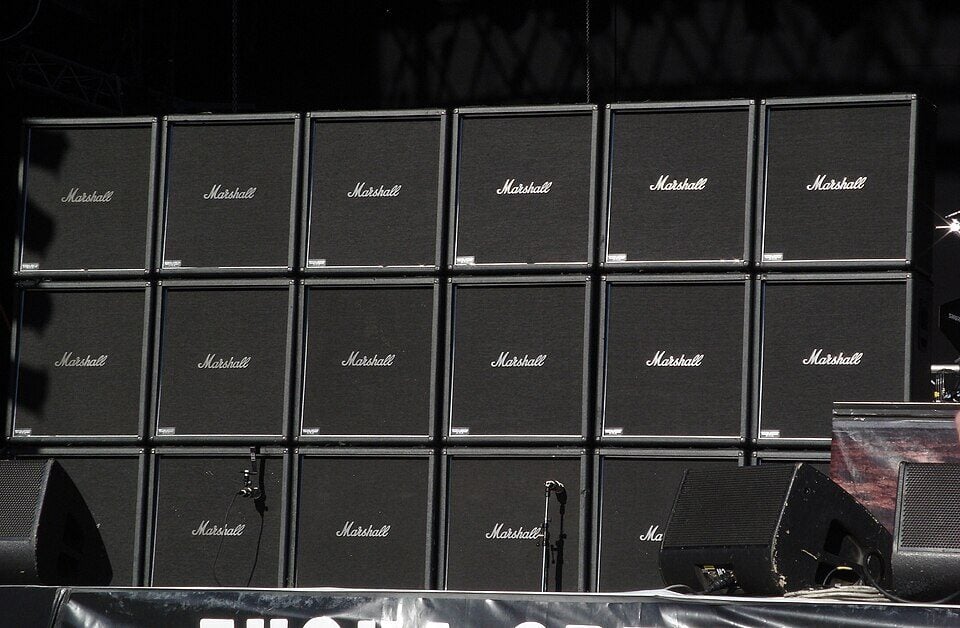
The stack became an iconic image of rock. Blue Öyster Cult used an entire wall of full-stack Marshalls as their backdrop in the early 1970s, and Slayer’s Kerry King and Jeff Hanneman often played in front of 24 cabinets. For players who wanted more power from a single stack, Marshall built the 200-watt Major from 1967 to 1974. In 1981 the JCM800 series followed. Its model 2203 became a staple among hard rock and heavy metal players.
Key facts
- Founded: 1962 in London by Jim Marshall
- First amplifier: the JTM45 (1963), inspired by the Fender Bassman
- The classic stack: one head on two 4×12 cabinets
- Marshall Major: 200 watts, built 1967–1974. Associated above all with Ritchie Blackmore and Mick Ronson
- JCM800: introduced in 1981, replaced by the JCM900 in 1991
Sources: Wikipedia, “Marshall Amplification”, Wikipedia, “Marshall Major”, Wikipedia, “Marshall JCM800”
Photo: MarshallStack Slayer by Jaakonam, CC BY-SA 3.0, via Wikimedia Commons.
