
Mesa/Boogie and the Dual Rectifier
Players & bands
John Petrucci - Dream Theater
Mesa documents Petrucci’s long association with the Mark IIC+, Dual Rectifier and other Mesa amplifiers. His JP-2C signature amplifier is based on the Mark IIC+ platform. It is not a Dual Rectifier. Compare the particular model and era when exploring his sound.
Source: Mesa: John Petrucci and the JP-2C
Mesa/Boogie began in 1969 as Randall Smith’s small repair shop, where he modified Fender amplifiers, above all the little Fender Princeton, to give them much more gain. In the early 1970s Smith pioneered “cascading” gain stages and built what became the industry’s first high-gain amplifier, simply called the Boogie. Mesa/Boogie is often called the first maker of boutique amplifiers.
Its Mark IIC+ of 1984–85, with an aggressive, midrange-heavy sound and a tight low end, was taken up early by heavy metal guitarists such as Kirk Hammett and James Hetfield of Metallica. When simpler designs by Marshall, Bogner and Soldano took over at the end of the decade, Mesa answered in 1991 with the Dual Rectifier, a “big, monster-metal head” with a steel diamond faceplate. Its success made Mesa a staple of modern rock tone. Gibson acquired the company in 2021.
Key facts
- Founded: 1969 by Randall Smith. Based in Petaluma, California, since 1980
- First high-gain amplifier: the Boogie, released in 1972
- Mark IIC+: fewer than 3,000 made between January 1984 and March 1985
- Dual Rectifier: introduced in 1991, inspired by the Soldano SLO-100
Source: Wikipedia, “Mesa/Boogie”
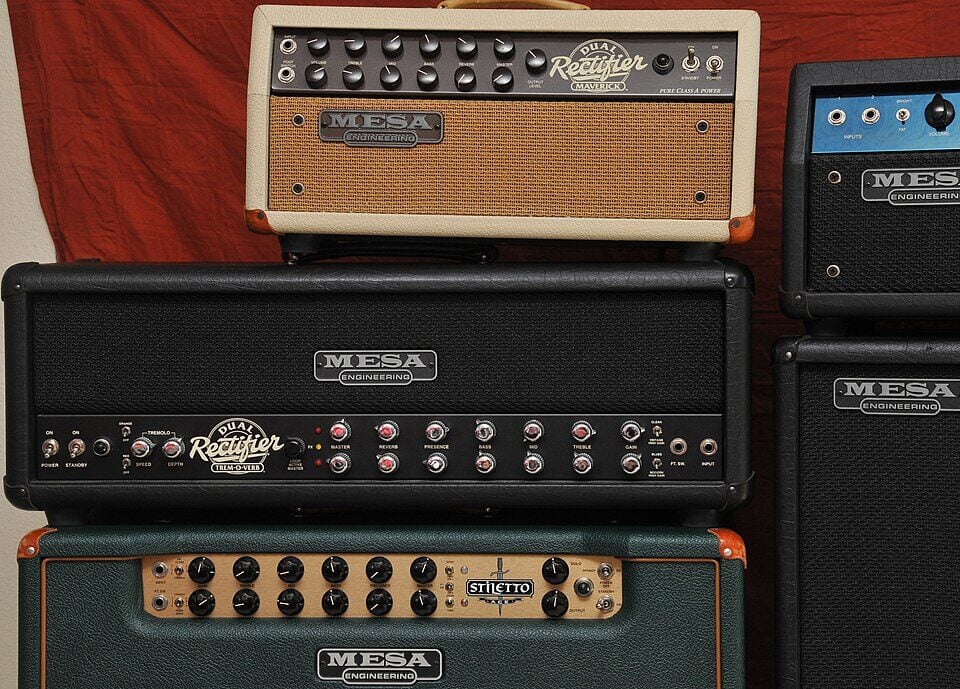
Photo: Mesa Boogie Maverick, Tremoverb, Stiletto Ace by ArtBrom from Seattle, CC BY-SA 2.0, via Wikimedia Commons.
