
The seven-string guitar
Players & bands
James “Munky” Shaffer - Korn
Ibanez’s Munky artist page documents the Korn guitarist and his APEX signature instruments. The extra low string expands a guitar’s range. It does not specify one tuning, scale length or pickup set for every seven-string player.
Source: Ibanez: Munky of Korn
Seven-string guitars are older than metal: the Russian guitar has seven strings, and jazz guitarists such as George Van Eps, from the late 1930s, and Lenny Breau played seven-strings before metal did. The first mass-produced solid-body seven-string, the Ibanez Universe, was developed with Steve Vai as a seven-string version of his JEM. Vai first tried an extra high A string, then added a low B instead, and played prototypes on Whitesnake’s Slip of the Tongue.
Demand was low at first, and Ibanez made no Universe guitars in 1995. Korn changed that: they featured Universe guitars on their 1994 debut album, and Ibanez reintroduced the model in 1996 as metal bands from Dream Theater and Fear Factory to Meshuggah, Cannibal Corpse and Morbid Angel adopted it. The low B became the usual tuning, used by Trivium, Dream Theater and Haken. Eight-string guitars took the idea further, and the djent deck tells Meshuggah’s part of that story.
Key facts
- First mass-produced solid-body seven-string: the Ibanez Universe, developed by Steve Vai (released in 1990 according to the Ibanez Universe article, the Steve Vai article gives both 1989 and 1990)
- Usual tuning: a low B added below standard tuning (B–E–A–D–G–B–E)
- Breakthrough in metal: Korn’s 1994 debut album
- No Universe guitars in 1995. Reintroduced by Ibanez in 1996
Sources: Wikipedia, “Seven-string guitar”, Wikipedia, “Ibanez Universe”, Wikipedia, “Steve Vai”
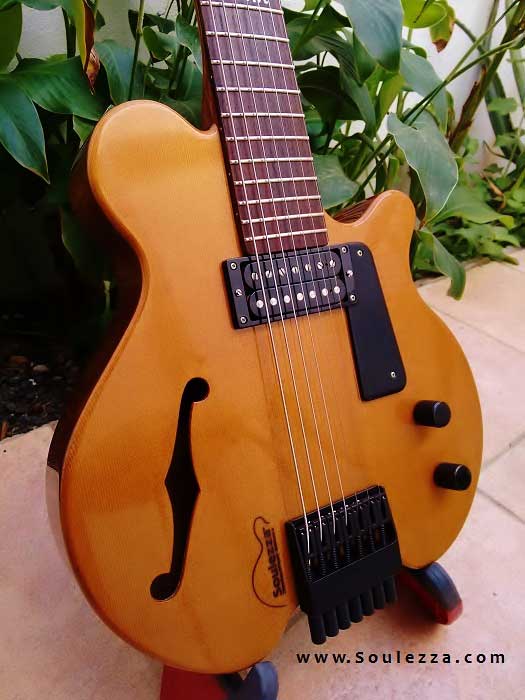
Photo: Seven-string guitar. Soulezza 7 String Guitar.jpg — Soulezza Guitars. CC BY-SA 4.0. Source image used without further edits; display may resize or crop.
